It’s not the risk. It’s the resource.
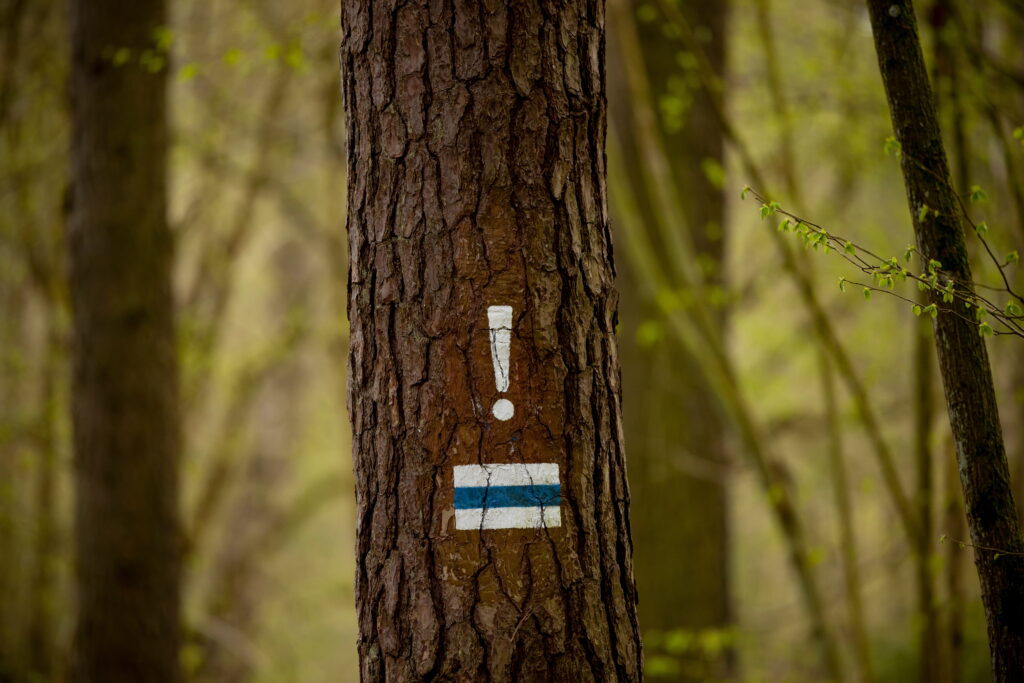
Author’s note: Selecting the right image for each article I write is part of the work. But it’s also a part I relish because I’m a visual person myself. When I come across something that halts my eye, I know I’ve found it. As it happened this week. What you see in the image above is something hikers will recognize. It’s a trail marker. It’s information for hikers, left by someone who went before. For us, it confirms that failure can be framed as a useful signal rather than a warning. Either from our own previous experience or that of others.
You delay the decision. You research it one more time. You hold onto the thing longer than you should. You avoid the conversation.
Do any of those sound familiar? They certainly do to me.
We tell ourselves we’re being careful, or just thorough. That we’re being responsible. But most of the time, we’re only fooling ourselves with those platitudes.
We’re not weighing the decision at all — we’re avoiding what we think failure would mean if we got it wrong.
We’ve been taught to read failure as a warning sign. Something to flinch from. Something that shows up at the end of a bad decision, confirming we shouldn’t have made it.
But what if we’ve been reading the signal backwards?
What if failure isn’t the consequence of a decision — but one of the inputs required to make better ones?
Here’s the line I keep coming back to from the work I’m doing now:
Everything makes something else possible. Including failure.
Failure isn’t there to stop you. It’s there to work for you — if you’ll let it.
That shift — from failure as risk to failure as a resource — changes everything downstream. It changes what you’re willing to try. It changes how long you will sit with a decision before you make it. And it changes what you do with the ones that don’t go the way you hoped.
All of that brought me to the thoughts I want to share with you here and to walk through what failure actually does for us when we stop treating it like an enemy and start treating it like a collaborator.
Seven things, one for each letter of the word itself.
F — Freedom
A — Awareness
I — Interrupt
L — Leverage
U — Uncover
R — Reframe
E — Elevate
That’s a progression.
Release. See clearly. Break the pattern. Use what you’ve got. Expand the possible. Change the meaning. Rise with it.
That’s the arc. Let’s walk it together.

FREEDOM
There are many reasons we avoid decisions. But the reason most people will give, when pressed, is fear. Not just any fear — the fear of failure. What if I get it wrong? What if this derails everything? So fixated on what could go wrong, we lose sight of what we’re resisting on the other side of the decision.
That’s why, to fully embrace failure as not just an unavoidable part of life but a necessary part of success, we have to free ourselves of that fear. Once we recognize that we have agency over the decision and everything that follows, we can see it as part of how and what we build, rather than a verdict on our worth.
For many years, I passed up opportunities to advance in my career because I was afraid I would be rejected for not having a college degree. I didn’t think I would fail at the job. I thought I would fail at getting the job. Rather than have to face that rejection (failure), I just didn’t try.
I decided to call my own bluff and went back to college in my 50s, finishing the degree. What I found out was that the opportunities had never been beyond me. I was placing myself beyond them. What I learned from going back to college was that the degree didn’t open doors. Deciding I was allowed to knock on them did. And when I looked back, I saw how many doors I’d walked past because I’d decided — before anyone else got a vote — that they weren’t mine to open.
I realized there were many lost chances due to that false narrative. That’s what fear does. It gives us a picture that’s meant to contain us, not free us. Failure, on the other hand, is there to do just the opposite. It sets us free from that fear so that we can move.
AWARENESS
I spent a good portion of my career in business intelligence. We gathered data, studied it, sorted it, and handed it back so others could make better decisions. But no matter how thorough we were, it didn’t always lead to the best choices — because there’s no way to fully exhaust the data or model every scenario that could happen. In many cases, what we missed only became visible after the decision had already missed the mark.
That’s the hard truth about information. It can only tell you what’s knowable in advance. And most of the decisions that matter live in the space where the knowable runs out.
Failure is what reaches into that space. It shows you what the research couldn’t — not because the research was bad, but because some things simply cannot be known until you move. Over-research is my trap. And what I’ve had to learn, slowly, is that over-research is fear wearing the costume of diligence. It looks productive. It looks responsible. But past a certain point, more data isn’t making the decision clearer — it’s just delaying the moment when you find out what you couldn’t have known anyway.
Failure gives you that information in a way no report ever could. It also does something else, something I didn’t expect: it shows you how much of what you feared was never real to begin with. Most of the catastrophes we spend our energy trying to prevent never actually arrive. The ones that do arrive are usually smaller and more survivable than the version we built in our heads.
That’s awareness. Not just seeing what happened. Seeing what was real.
INTERRUPT
There’s a meeting you’ve been meaning to have. A hire you know isn’t working. A direction the business took eighteen months ago that hasn’t played out the way you thought it would. You keep moving. The calendar fills. The quarter closes. And the thing you know isn’t right keeps getting ignored.
Then something happens. A client leaves. A number comes in low. A conversation you weren’t expecting forces the issue into the open. And for a moment — usually an uncomfortable one — everything stops.
That moment is the gift. Most of us treat it like a setback.
Failure interrupts. That’s its job. Not to end the journey, but to break the momentum long enough for you to see what the momentum was hiding. It’s the trail marker on the tree — the painted exclamation mark that tells the hiker the path just changed, pay attention. It isn’t telling you to turn around. It’s telling you that autopilot stopped working a while ago, and you didn’t notice until right now.
The hardest part isn’t the interruption itself. It’s what we do with the pause it creates. Most of us rush to fill it. We explain the number. We reframe the client departure. We tell ourselves a story that puts the momentum back where it was, because momentum feels safer than stopping. But the pause is where the choice lives. The pause is the whole point.
When you let the interruption actually land — when you let the failure do what it came to do — you get something you can’t get any other way: a clean look at the path you were on, from a standing position. You can see the turn that’s already happened. You can choose what comes next instead of inheriting it from what came before.
That’s what failure is offering when it interrupts you. Not a verdict. A vantage point.
LEVERAGE
What does this make possible? It’s the closest I have ever come to having a true-life mantra. It’s not about being opportunistic. It’s about leverage. If you believe, as I do, that everything makes something else possible, failure has to be in that realm as well.
When I wrote my first book nearly 10 years ago, it focused on resilience. The title is Adjusted Sails: What does this make possible? I had gone from an empty nest season to losing my job to facing a significant health scare. All within a condensed amount of time. Wave after wave of what felt like getting knocked down. I had to find a way to get back up. It started with understanding each of those situations as something other than failure.
That’s where I realized we already have what we need, when we need it — if we’re willing to see it. And to invest it as a resource into what’s next. That’s the essence of leverage.
What we might initially see as failure is ripe with possibilities for leverage. Not just within that moment, but for the future as well.
I learned that the failures I was trying to hide were the very ones that could be teaching the most. And not just because what you bury, you repeat. Because it is also often where you have the most potent opportunity to serve others.
UNCOVER
There’s an old saying — it’s been attributed to Alexander Graham Bell, to Helen Keller, and to Cervantes before either of them — that when one door closes, another opens, but we often look so long and regretfully at the closed door that we miss the one that has opened for us.
The quote has traveled through so many voices because the pattern it names is that universal. We stare. We linger. We replay the closing. And while we’re doing that, something else is becoming available that we aren’t looking at yet.
That’s what failure does at the level of a single decision. It closes a door you were counting on, and while you’re standing there trying to understand why, it’s revealing something else. Information you didn’t have. A possibility you couldn’t see from where you were standing. A version of the path that was never visible to you until this door had to close.
The same pattern shows up in the physical world all the time, at a much larger scale.
Earthquakes reveal to us what the Earth is made of. Seismic activity has taught geologists more about the planet’s interior than any other source of information. When the plates shift, they expose rock that had been buried for millions of years. What feels like a catastrophe from the surface is also — at the same time — the only way certain information about the world becomes available.
The science is one thing. Living it is another.
When my daughter and her family moved to Alaska in 2018, they experienced a 7.1 earthquake that November. What I watched them learn over the months that followed wasn’t just how to prepare for the next one. It was how to live alongside the knowledge that the ground could move again at any time. They had to make peace with a kind of uncertainty most of us never have to reckon with directly. You see and feel things differently when you’ve been inside them.
My own version was milder. I was stuck in an elevator in California during a quake once. The whole building swayed. There was nothing to do but wait. When it stopped, and the doors finally opened, I walked out into a world that had been rearranged by something I couldn’t see and couldn’t control. I couldn’t tell you what had changed. But I knew something had.
That’s what failure does, too. The shaking ends. The doors open. And the world you walk into is not the one you walked out of.
REFRAME
The idea of framing and reframing was more literal for me before I decided to pursue life coaching as a possible next career season.
I love art. I always have. Some of my treasured pieces go back decades. But of note is the fact that I rarely kept the artwork in its original frame. In fact, sometimes I bought a piece just for the frame because I had a different, but perfect painting for it.
So when the master coach who led the training cohort said that one of the key values coaching brings is the ability to help ourselves and others reframe situations, events, and ideas — it became an extension of what I’d already discovered in a physical application.
How we see things depends, in part, on how they’re presented to us. But only in part — because we can change the presentation. That’s what reframing is. And it’s led me to one of my favorite discoveries: perspective is truth in motion. Because we can change where we’re standing, we can see what’s true from a different place.
But changing perspective isn’t spontaneous combustion. It needs a catalyst. And quite often, what we first see as failure is exactly that.
The question then becomes what the failure is trying to show us. Not to review what happened, but to change what happens next.
As a possibilitarian, I try to live by another often-quoted truth: when you change the way you look at things, the things you look at change. Failure is one of the forces that lets that shift happen. It hands you the new frame whether you asked for it or not.
Failure doesn’t change the facts of what happened. A different frame doesn’t change the actual painting. But in both cases, the meaning changes. And the meaning is almost always what we were really responding to in the first place.
ELEVATE
Some of my favorite memories from childhood and my teenage years are of family trips from our home in Ohio to West Virginia. We went to visit my grandparents and to see the places where my parents had grown up.
One spot that my Dad and I frequented was Hawk’s Nest State Park. We climbed the peak of Gauley Mountain for the breathtaking view of the New River below. I didn’t just see a place. I saw history. My Cherokee ancestors had lived along that river. They had walked where we were walking. They had stood on this ridge. I didn’t have anything to prove that other than how it felt, but their story became real to me from that elevation.
Sometimes, we cannot see what it is we need to see until we can go to a higher plane. It’s still about perspective, but it takes stepping out of the frame for this one.
When we are in the throes of what feels like failure, it can be easy to see only what is staring us in the face when what we need is to rise above that and see the whole vista. When we do, two things happen. Where we are becomes clearer. And what’s just beyond us — the thing we couldn’t see from the ground — comes into view. Failure is often what lifts us high enough to see both at once.
You don’t get better at decisions by making more of them; you get better by letting each failure raise the floor you make the next one from. Because once you’ve experienced the view from above, you’ll know how to find it again.
Which of those attributes of failure resonated most with you? While these do show a progression, it doesn’t mean that every failure does all of them every time. And, you may find, as I did, that as you work through them, you also begin to improve your overall decision framework because the lens keeps adjusting.
In his recently released book, How to Get a Return on Failure: Fail Smarter—Return Stronger, John C. Maxwell talks about this as moving from apprehension to appreciation of failure. His thesis is that to get a return on something, we have to first appreciate its value.
“Appreciating failure means properly estimating the advantages it brings as you learn from it. The ability to deal with failure opens doors to the exploration of new territory and a life of greater potential.”
That progression from apprehension to appreciation is what the seven letters are tracing. Freedom is where apprehension loosens its grip. Elevate is where appreciation finally settles in. Everything in between is the work of getting from one to the other.
Here are three ways you can begin that practice for yourself:
- Pick one decision you’ve been circling for more than two weeks. Not the biggest one — just one. Now ask: am I stuck because the decision is actually unclear, or because I haven’t decided what failure would mean if I got it wrong? (Write down the answer before you do anything else.)
- Look at the four behaviors I’ve mentioned — delaying, over-researching, holding on, and avoiding. Which one is running right now, in your life, today? (Name the decision underneath it. That’s where failure can work for you.)
- For the next decision you face this week, don’t ask “what if this fails?” Ask “what could failure here make possible?” (Then decide.)
The decision you’ve been avoiding isn’t waiting for more information. It’s waiting for you to decide what failure would mean — and decide it doesn’t mean what you’ve been telling yourself it means. That’s the only decision underneath the decision. Everything else is just the path.
When we stay focused on finding the good in every situation — and on what it is making possible — success becomes inevitable.
That’s what I want for you, for all of us.